
West Nusa Tenggara (NTB) faces a high incidence of poverty. An estimated 700,000 people live with only 2 EUR per day to go by. They struggle to provide for themselves and their families. Since there are not many economic prospects apart from agriculture and other informal sectors in the area, many individuals look for alternative opportunities abroad.
The Indonesian government promotes international labor migration to address labor surpluses and stimulate the local economy. NTB is currently known as one of the largest sources of migrant workers in the country; it sends over 46,000 people abroad annually. Unfortunately, many of these migrants lack essential knowledge and skills. They are also often unaware of their rights.

Our commitment to protection, empowerment, and economic security
Consequently, indonesian migrant workers often find themselves in occupations such as domestic service and plantation work, which are not usually covered by labor laws. Some migrants also take undocumented migration routes as it is easier to traverse. In these situations, they are exposed to the dangers of human trafficking and various crimes such as slavery and physical as well as sexual abuse. Furthermore, they have only limited access to vital information and legal assistance. Together with PPK, we have been working to ensure that migrant workers and their families in NTB are protected, empowered, and economically secure. We are lobbying for the improved enactment of policies on the protection of migrant workers and their families, strengthening community-based organizations to advocate for safe migration and anti-trafficking, and encouraging the setting up of micro-businesses to provide migrant workers and their family members alternative sources of livelihoods.
Early successes: Growing support at village level
AWO International and PPK have been in partnership since 2018. While progress has been slow, there has been a growing support for village-level initiatives. Village government leaders have signed operating procedures and guidelines on the protection of migrant workers into law, several migrant community-based organizations (CBO) organized by the project are now registered entities with budgets for their operations and activities funded by their local government, PPK’s partnerships and collaborations with migrant worker networks and related stakeholders have increased. Members of our CBOs our partnership also had key roles in handling and referring to relevant government agencies cases of trafficking and abuse. Additionally, a few of them were also trained on entrepreneurship and business management under the project and were able to access financial services and technical assistance from financial and government institutions. In the current project, our partnership with PPK aims to continually level up these groups’ potential.

Teniga Daye, one of the community-based groups we organized, successfully set up a coffee business with the project’s help. They locally source, pack, and distribute their coffee beans to several businesses across the island.

Our project holds regular community education sessions to raise awareness on subjects like migrant worker documentary requirements, rights of migrant workers’ families, official sources to refer to.

PPK collaborates with the government, private sector, and relevant civil society networks to advance their cause.


Projectinfo
| Place/Region | North Lombok, West Nusa Tenggara, Indonesia – specifically in the following villages: Medana Village, Tegal Maja Village, Sambik Bangkol Village, Teniga Village, Rempek Village |
|---|---|
| Partner | Perkumpulan Panca Karsa (PPK) https://pancakarsa.or.id/ |
| Target group | Potential, current and returned migrant workers; victims of human trafficking; community representatives and local government officials |
| Activities |
|
| Duration | 01 January 2024 to 31 December 2026 (cooperation since 2018) |
| Budget | 228,000 EUR (3 years) |
| Sponsor | German Federal Ministry for Economic Cooperation and Development (BMZ) |
You might also be interested in
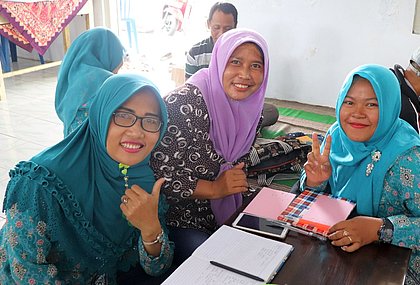
Building Strong Support Systems for Migrant Workers and their Families
Together with INFEST, we empower communities through comprehensive socio-economic and legal support. By fostering resilience, skills development, and driving policy improvements, we pave the way for a more secure and prosperous future for migrant workers and their families.
more information
Fostering Resilience in Local Migration Governance
The Philippines has embraced international labor migration and become one of the biggest labor exporting countries in the world. Despite migrants’ crucial role on the country's economy, the country has inadequate systems to support them. AWO International and the Center for Migrant Advocacy Philippines (CMA) are focused on bettering migration policies for OFWs and their families.
more information