
Nutrition, Income, Climate Resilience
In so-called farmer field schools, smallholder farmers learn how to grow fruits and vegetables in kitchen gardens and apply climate-adapted cultivation methods. This strengthens food security, protects soil and water resources, and increases yields. Training in the processing and marketing of agricultural products, as well as soap production, also creates additional sources of income. Community-based savings groups provide mutual support, for example through small loans for school fees, medical care, or investments.

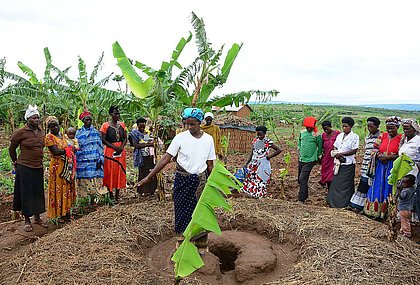
We train farmers in nutrition and food security through climate-resilient backyard gardening. This method allows households to grow vegetables on small plots using locally available materials. By mixing sandy soil, ash, and organic matter in sacks or basins, families can grow nutritious vegetables right at home - without needing large areas of land.
Cordy Bosco Tumarani, staff member at COVOID
Gender Equality and Social Cohesion
Women in Isingiro face heavy burdens – including labor, limited access to education, gender-based violence, and lack of family planning. To empower them, the project promotes radio programmes, information materials and a local health network. Multipliers share knowledge on gender equality, violence prevention, and family planning.
Dialogue & Environmental Protection
Dialogue platforms promote peaceful coexistence between refugees and local communities and support the joint resolution of resource-related conflicts. This not only strengthens social cohesion, but also promotes the sustainable use of environmental resources.

Self-organisation of savings groups fosters the economic independence of refugees and local communities.


Regular field visits enable direct exchange with the partner organisation, the communities and the refugees.

Training in the marketing, processing and sale of products creates new sources of income.


Projectinfo
| Place/Region | Nakivale Refugee Settlement, Kakingi, and host communities, Isingiro District |
|---|---|
| Partner | Community Volunteer Initiative for Development (COVOID) |
| Activities |
|
| Duration | January 2026 – December 2028 |
| Budget | 224.331,83€ |
| Sponsor | Federal Ministry for Economic Cooperation and Development (BMZ) |
You might also be interested in
Acting in solidarity, creating lasting change - for a just future in Uganda
Lamwo District in northern Uganda is one of the poorest regions in the country and at the same time a place of refuge for many people from neighboring South Sudan. Together with the Ugandan organization UCOBAC, we support refugee and local communities in securing their nutrition, generating income, and strengthening social cohesion.
more information
Stronger together: Securing food and promoting peace in Uganda
Bidibidi in northern Uganda is one of the largest refugee settlements in the world. Many people there live in poverty and are affected by hunger. Together with our partner organisation AFARD, we support refugee and local families and work to improve their living conditions.
more information
Strengthening resilience and food security in Uganda's West Nile region
In Uganda's West Nile region, we are working with RICE West Nile to strengthen refugees and local communities - through food security, climate-resilient agriculture and targeted support for women and young people. For better living conditions and a brighter future.
more information