A multi-crisis: the economy, social services, and infrastructure are collapsing
“The profound humanitarian and economic crisis in Cuba constitutes an emergency whose scale and severity affect almost every aspect of life,” says Rita María García Morris, Director of CCRD-Cuba, describing the current situation in Cuba. However, this situation is not new, and its causes are complex. Alongside internal structural challenges, such as low productivity, dependence on imports and a lack of reforms, the US embargo, which has been in place for over 60 years, also plays a central role. At the start of this year, energy sanctions under the Trump administration were further tightened. This is making it increasingly difficult to import fuel, secure loans, carry out international transactions and deliver goods. However, it is the civilian population that is particularly affected, suffering the consequences of the geopolitical blockade.
Poverty and hunger weigh heavily on the population
Recent studies show that around 89 per cent of Cubans live in extreme poverty. That equates to over 9 million people. The average income of Cubans is often not even enough to cover basic necessities such as food, transport or stable housing. Many people are struggling to survive from one day to the next. Families have to cut back on meals and are dependent on remittances from abroad or on the informal economy. Everyday life is characterised by shortages. In the capital, there are often power cuts lasting more than 20 hours at a stretch; in rural parts of the country, these can last up to 72 hours, explains García Morris. This has a massive impact on the population’s quality of life and makes it difficult for hospitals, schools and food warehouses to operate. Furthermore, the fuel shortage leads to regular disruptions to public transport and paralyses local agriculture. Over 70 per cent of the population has no reliable access to clean water. Waste collection has also collapsed in many places, with consequences for hygiene, the environment and public health.
The elderly, families, and people with disabilities are particularly affected
More than a quarter of the Cuban population is over 60 years old. Many older people live alone and are forced to continue working despite their age, as their pensions are barely enough to survive on. Furthermore, only just under a third of essential medicines are still available. People with chronic illnesses are particularly hard hit. At the same time, more and more skilled workers, and doctors in particular, are leaving the country. There is a lack of care services and stable social networks as a result of emigration, poverty and the withdrawal of state support. The burden on families, especially on women, is increasing significantly. Many can only afford one meal a day, and a large proportion of children are suffering severely from food shortages. Fruit, vegetables and protein-rich foods are scarcely available to many. Schools, which used to serve as social safe spaces, are now in a state of serious disrepair and there is a shortage of teaching staff. All-day care centres, often for particularly vulnerable children, are striving to provide a minimum level of care under extreme conditions. Accessible transport, assistive devices such as wheelchairs or hearing aids, and social support for people with disabilities and their families are now scarcely available.
A call for international solidarity
The director of CCRD-Cuba warns against viewing the current situation in Cuba merely as a difficult phase: “It is a turning point with long-term implications for the well-being of millions of people. Recognising the complexity of this crisis is essential for developing effective measures based on the realities of life for the Cuban population.” To resolve this multidimensional crisis, protection for the population is needed, along with an end to state violence and comprehensive reforms that enable greater freedom and better governance. International cooperation must also focus on people’s needs and dignity. “International solidarity and humanitarian response are arriving at a critical stage,” says García Morris, “because whilst they cannot resolve the crisis on their own, they do save lives and strengthen local capacities. They bring hope back to where it is most urgently needed.” This is precisely why our solidarity is so important right now.
AWO International Takes Action
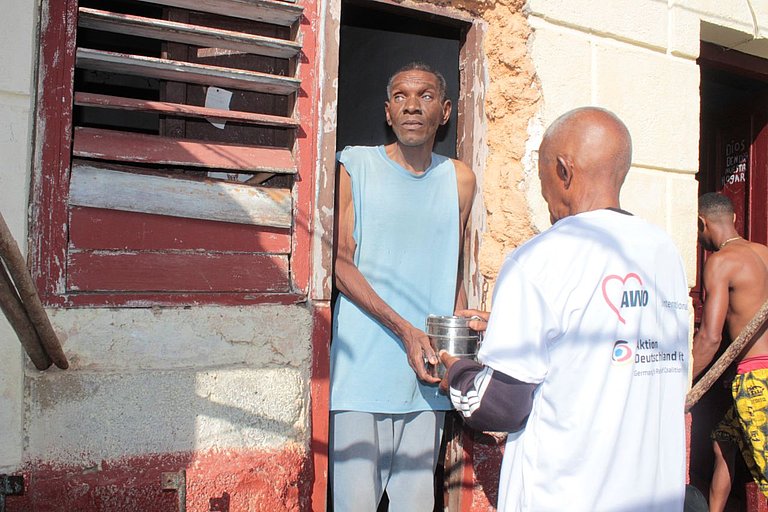
AWO International is working in partnership with the local organization Centro Cristiano de Reflexión y Diálogo (CCRD-Cuba) to provide rapid and direct emergency aid: We are distributing food packages containing rice, beans, and oil, as well as hygiene kits with soap and detergent, to particularly impacted groups. To do this, we are collaborating with schools, centers for people with disabilities, and a retirement home. Supporting these facilities helps relieve the social infrastructure of the communities and maintain the function of safe spaces for particularly vulnerable groups. Additionally, we provide direct support to 15 families headed by single mothers. Food packages provide relief for the families and help combat malnutrition in children. The installation of solar panels also ensures the power supply for a retirement home, enabling water purification and meals to be provided. Through our work, we reach 300 people in the communities of Colón and Cárdenas.
To implement these humanitarian measures, we rely on your support. Every donation helps to reduce hunger and poverty and give people hope.
AWO International
IBAN: DE87 3702 0500 0003 2211 00
Stichwort: Nothilfe Kuba