
Most people living near the coasts of Sarangani Bay rely on small-scale fishing and are heavily dependent on fishing as their primary source of livelihood. These fishing communities find themselves in precarious situations. Illegal and unregulated fishing, increasing waste pollution, changing climate conditions, and other factors are contributing to the decline of fish stocks in local waters. To secure their livelihoods, many are forced to spend longer periods at sea or venture into more distant international waters, which exposes them to risks such as human trafficking or detention.
At the same time, families face the challenge of managing the absence of their fishing members. Partners and older children often take on additional responsibilities to provide for the family. Unfortunately, this path frequently leads to debt traps, dropping out of school, prostitution, and other difficult situations.
Since 2018, OND Hesed Foundation and AWO International have been working to reduce the risks of abuse and human trafficking for fishing communities. Building on the potential of the fishing communities living near the coasts of Sarangani Bay, fishers and their partners have been organized into fishing associations and self-help groups. Over the past six years, these groups have been continuously strengthened through training and educational programs on topics such as leadership, rights of fishers and seafarers, paralegal and case management, coastal resource management, and many other subjects. These measures aim to foster their commitment to the socioeconomic protection of their families and communities, and to strengthen their sense of responsibility for ecological regeneration.

A unique thing about our project is that we do not just capacitate fisherfolk on their rights and raise their awareness on lobbying for their interests. We also motivate them to become environmental stewards. Our project involves them in activities like mangrove and tree planting, coastal clean-ups, and many others. I am more conscious of wanting to help my community and protecting our environment as it is the least we can do to respond to the changing climate.
Jennilyn Hualde, project coordinator for our project with OND Hesed
Milestones and Future Plans
Over the years, we have made significant progress. Many of the fishing associations and self-help groups are now officially registered in the Philippines. This facilitates their access to government programs and services and gives them influence in public consultations and policy decision-making. The latter played a role in the recent revision of the local fisheries code in General Santos City and parts of the province of Sarangani, which now also includes measures for the partners and families of fishers - such as the inclusion of youth and women in training programs as well as educational support for their children. The information centers established through the project have also helped to streamline the referral process for cases of human trafficking and abuse. Furthermore, the associations and groups are using the skills they have acquired through the project to train new members, take on social enterprise projects, and independently monitor their own progress.
From 2024 onwards, these groups and associations will continue to be strengthened in order to eventually become agents of safe migration and ecological responsibility in their communities and beyond. Additionally, the concept of social entrepreneurship and disaster risk reduction will be integrated into the project. OND Hesed is gradually reducing its involvement in providing technical support for community management and the integration of social entrepreneurship, in order to allow the groups to become familiar with gaining autonomy.

The strengthened partnerships of our project with government agencies have provided fishers and their families with many insights and benefits. So far, the groups have built their capacities in organizational development within the framework of the project and have received support from local governments to acquire new skills in the areas of aquaculture and environmental protection.

The fishing communities along the coast remember the times when their homes were flooded during heavy storms. Members of fishing associations and self-help groups are actively and voluntarily planting seedlings in designated areas along the coasts of Sarangani Bay, alongside similar activities such as waste management and coastal clean-ups. Since the planting of the seedlings, the communities have benefited from having water buffers during the rainy season.

Healthy coasts, secured futures: Ecological responsibility and socioeconomic protection go hand in hand.

Education as protection: Women and young people are actively included in community programs.


The members of the fishing associations indicate which skills they would like to be trained in, and the project facilitates these. Our project has already conducted training sessions on fish catch value addition, dumpling production, and other skills that enable them to generate additional income.


Projectinfo
| Place/Region | City of General Santos in the Province of South Cotabato, and Municipalities of Kiamba and Maasim in the Province of Sarangani, Philippines |
|---|---|
| Partner | OND Hesed Foundation, Inc. |
| Activities |
|
| Duration | 01 January 2024 to 31 December 2026 (cooperation since 2018) |
| Budget | 223,000 EUR (3 years) |
| Sponsor | German Federal Ministry for Economic Cooperation and Development (BMZ) |
You might also be interested in

Engaging Migrants and their Families in Migration Governance
There were close to two million Filipino migrant workers in 2022. More than half of them are women. Given the complexity of regular migration routes, many people resort to undocumented paths but fall victim to abuse and exploitation. AWO International and Mindanao Migrants Center for Empowering Actions (MMCEAI) are working together to facilitate a safer migration process.
more information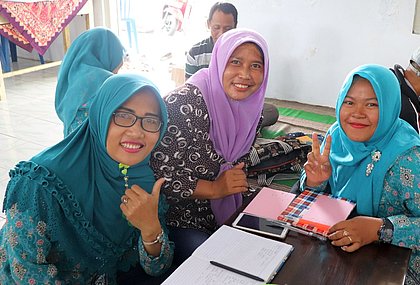
Building Strong Support Systems for Migrant Workers and their Families
Together with INFEST, we empower communities through comprehensive socio-economic and legal support. By fostering resilience, skills development, and driving policy improvements, we pave the way for a more secure and prosperous future for migrant workers and their families.
more information
Safe Migration: Support for Migrant Workers and Their Families in the Philippines
Filipino migrant workers often face numerous risks due to insufficient planning and a lack of protective mechanisms. Our project with Atikha aims to support migrant workers by improving the migration environment and assisting them and their families from pre-departure preparation to reintegration upon return.
more information